No Japanese car carries more mythology than the Nissan Skyline GT-R. It has a nickname — “Godzilla” — earned by destroying everything it raced. It has a cult following built through video games and movies. And it has a near-religious status among importers, who count the months until each generation crosses the 25-year line. But the GT-R didn’t start as a legend, and it didn’t even start as a Nissan. This is the story of how a modest sedan became the most worshipped JDM car of all.
- 1957Prince Skyline launchedThe Skyline begins life at the Prince Motor Company — not yet a Nissan
- 1966Nissan–Prince mergerThe Skyline joins the Nissan family
- 1969Hakosuka GT-R (KPGC10) — first GT-RS20 twin-cam inline-six. Wins on debut and dominates Japanese racing
- 1972Kenmeri GT-ROnly ~197 built before the 1973 oil crisis kills the badge
- 1973GT-R badge retired16-year silence as emissions rules tighten
- 1989R32 revival — RB26DETT, ATTESA AWDRacing R32 wins 29 straight JTCC races. Australian press names it "Godzilla."
- 1995R33 — sub-8-minute Nürburgring lapProduction-car lap of 7:59 breaks the eight-minute barrier
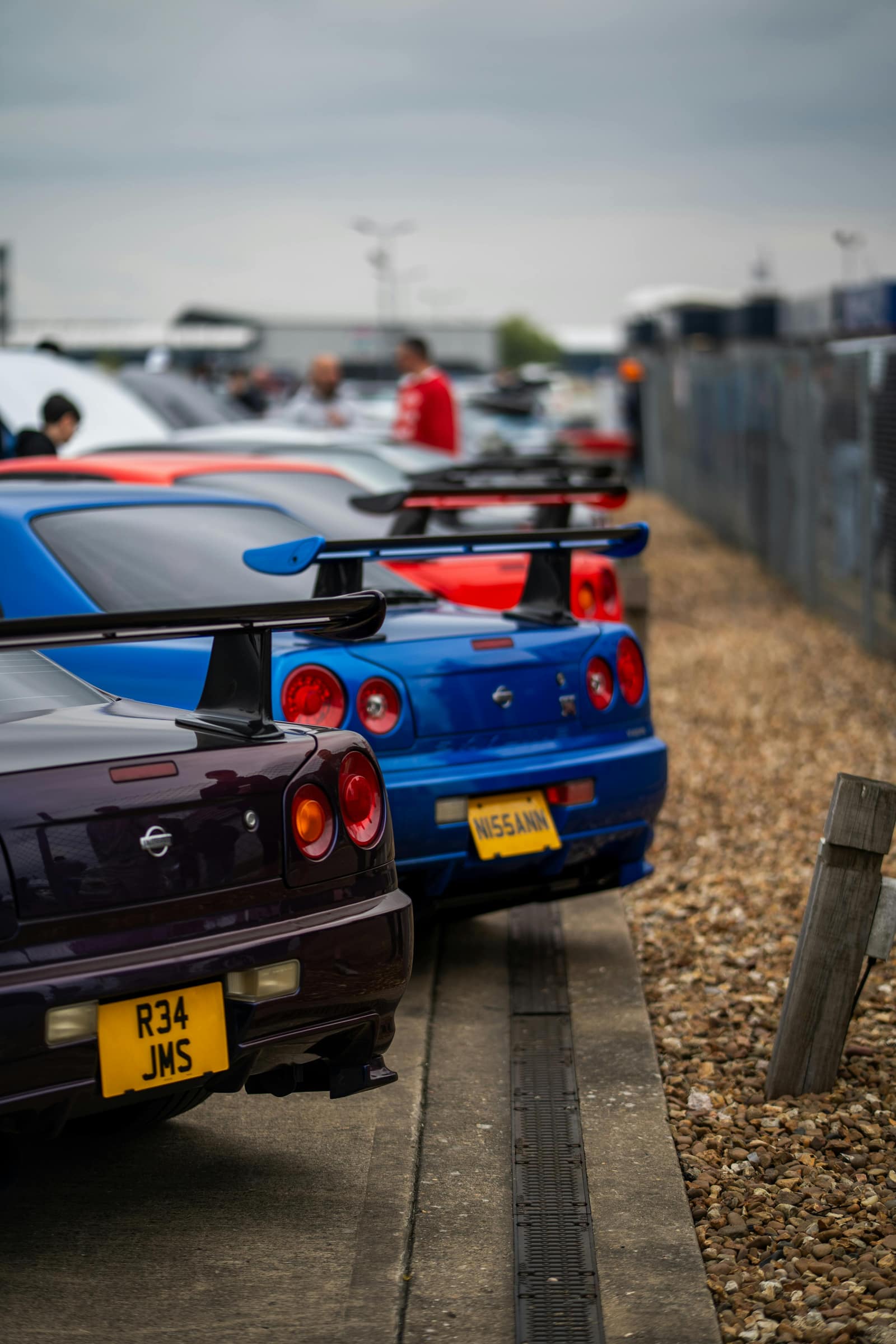
- 1999R34 — the definitive Skyline GT-RGran Turismo and Fast & Furious make it the dream car of a generation
- 2007R35 GT-R — global standalone modelFirst GT-R officially sold new in America. The classic Skylines remain import-only
The GT-R badge appeared for the first time on a car that debuted at the 1968 Tokyo Motor Show and launched in February 1969. Internally it was the KPGC10; enthusiasts call it the Hakosuka — a portmanteau of hako (box) and suka (short for Skyline). It was powered by the S20, a 2.0-liter dual-overhead-cam inline-six with four valves per cylinder, derived from Prince’s racing engine — exotic stuff for the era.
And it won immediately, taking the JAF Grand Prix in its debut race and racking up a dominant competition record against European machinery. The next generation, the 1972 Kenmeri (nicknamed after a “Ken and Mary” TV commercial), carried the badge briefly — but the 1973 oil crisis and tightening emissions killed high-revving sports cars, and only around 197 Kenmeri GT-Rs were built before the badge was retired. The GT-R then went dark for 16 years.
The R32 and the birth of “Godzilla” (1989)
The revival is where the legend was truly forged. In 1989, Nissan brought back the GT-R as the R32 — and it was a technological leap. It paired the new RB26DETT (a 2.6-liter twin-turbo inline-six, officially rated at 276 hp under Japan’s gentleman’s agreement, but really making closer to 300) with the ATTESA E-TS all-wheel-drive system and four-wheel steering. It was engineered with one obsession: to dominate Group A touring car racing.
It did exactly that. A racing R32 entered the Japanese Touring Car Championship in 1989 and won every single race it started — 29 in a row over four seasons. It took the Spa 24 Hours in 1991 and the Bathurst 1000 in Australia in 1991 and 1992. The domination was so total that the Australian motoring press dubbed it “Godzilla” — the monster that crushed everything. The name stuck to every GT-R that followed.
R33, R34, and global myth
The R33 (1995) refined the formula and set a production-car Nürburgring lap of 7:59 — symbolically breaking the eight-minute barrier. The R34 (1999) sharpened it further and became, for many, the definitive Skyline GT-R: the shape and sound that defined the car for a generation raised on Gran Turismo and the Fast & Furious films.
Crucially, none of these were officially sold in America. The GT-R was right-hand-drive, Japan-market — forbidden fruit. That unavailability, combined with on-screen fame and genuine racing pedigree, turned the Skyline GT-R into the most-wanted JDM car of all. In 2007, Nissan finally made the R35 GT-R a standalone global model sold in the US — but the classic Skyline GT-Rs remained import-only legends.
Why importers obsess over it
The GT-R sits at the exact intersection of everything that drives the import scene:
- Genuine pedigree — this isn’t hype over a badge; the car earned its reputation by winning, repeatedly and overwhelmingly.
- Forbidden-fruit status — never sold new in the US, so the only way to get a classic Skyline GT-R is to import one.
- The 25-year clock — each generation becomes legally importable as it turns 25. The R32 has crossed; later R32s and the R33/R34 generations are crossing now and in the coming years, which is why prices and demand keep climbing.
- Cultural saturation — Gran Turismo and Fast & Furious made it a dream car for millions who are now old enough to buy one.
This is why the GT-R is the headline act of the JDM import world. As earlier R34 builds reach 25 years, the most-wanted Skyline of all is finally becoming legal — and the scramble for clean examples is intense. If it’s your dream car, understand the eligibility precisely (it’s by build month — a few months matters enormously on an R34) via the 25-year rule explained, see the 2026 eligible JDM legends, and run the real numbers in the Landed Cost Calculator.
Frequently asked questions
Why is the Nissan GT-R called Godzilla?
The Australian motoring press nicknamed the R32 Skyline GT-R “Godzilla” after it dominated Australian touring car racing in the early 1990s — crushing the competition the way the monster crushes cities. The name stuck to every GT-R since.
Did the Skyline GT-R start as a Nissan?
No. The Skyline was first built by the Prince Motor Company in 1957. Prince merged with Nissan in 1966, and the first GT-R launched under Nissan in 1969.
What makes the R32 GT-R special?
The 1989 R32 revived the GT-R after a 16-year gap with the RB26DETT twin-turbo inline-six and ATTESA all-wheel drive. A racing version won 29 consecutive Japanese Touring Car Championship races and dominated Group A, earning the “Godzilla” name.
Was the Skyline GT-R ever sold in America?
The classic Skyline GT-Rs (Hakosuka through R34) were never officially sold new in the US — they were right-hand-drive, Japan-market cars. The R35 GT-R became a standalone US-sold model in 2007. Classic Skylines can be imported as they reach 25 years old.
When can I import an R34 Skyline GT-R?
By month of manufacture, 25 years after it was built. Earlier R34 builds reach eligibility starting in 2026; later 2001–2002 builds become eligible later. Verify the exact build date — on a car this valuable, a few months is the difference between legal and stranded.
From a merger to a monster
The Skyline GT-R’s path — a Prince sedan, a merger, a debut win, a 16-year disappearance, and a comeback so dominant it got named after a movie monster — is the greatest origin story in JDM. It’s why “Godzilla” is the dream car of the import world, and why each one crossing the 25-year line is an event. Understand the rules in our 25-year guide, see what’s eligible in 2026, and price your dream in the Landed Cost Calculator.
Sources
- Nissan USA — Skyline to GT-R evolution (official history)
- Motor Authority — Godzilla’s biography: 50+ year history of the Nissan GT-R
- Hagerty — Hakosuka, Prince origin, “Godzilla” naming
- Autoblog — RB26DETT and R32 Group A development
WATTSHIP intelligence is for reference and historical context. Eligibility is by month of manufacture and must be verified per vehicle; this is not legal advice. See our Disclaimer.