How to Import a Car from Japan in 2026: The Complete Guide
Importing a car from Japan is no longer a niche move reserved for collectors and specialists. In 2026, it is a practical way to buy a well-maintained vehicle that was never sold in your market — often for less than a comparable car at home, even after shipping and duty. This guide walks through the entire process end to end: how Japanese auctions work, what the real landed cost looks like in 2026, how shipping and customs unfold, and the rules that apply in the United States, United Kingdom, and Australia.
 By the end you will know whether importing makes sense for you, what it will actually cost, and how to avoid the mistakes that catch first-time importers.
Why import a car from Japan at all?
Japan exports hundreds of thousands of used vehicles every year, and there are structural reasons the supply is so deep. Japan’s strict shaken roadworthiness inspection makes it expensive to keep older cars on the road domestically, so vehicles are retired earlier and in better condition than equivalents elsewhere. Mileage is typically low, rust is limited outside the snow regions, and the auction system documents condition with a level of honesty most domestic used-car markets never match.
For buyers, that means three advantages: access to models never officially sold in your country, generally better mechanical condition for the age, and transparent condition grading you can verify before you ever place a bid.
The five stages of importing a car from Japan
Every import — a single enthusiast car or a container of vehicles for resale — follows the same five stages.
Stage 1 — Find the vehicle
Most export-bound vehicles move through auctions run by houses such as USS, TAA, JAA, and Aucnet. These are wholesale auctions; you generally access them through an exporter or platform rather than bidding directly as a foreign individual. The alternative is a fixed-price listing from a dealer or exporter, where the price is set and there is no bidding clock. The auction route usually offers better prices and far more selection; fixed-price offers certainty. Most first-timers start with fixed-price and move to auctions once they understand grading.
Stage 2 — Read the condition honestly
Each auction vehicle comes with an inspection sheet prepared by a third-party inspector: an overall grade, a panel-by-panel damage map, and standardized marks for mechanical and interior condition. Learning to read these sheets is the single most valuable skill in importing. A car that photographs beautifully can carry a sheet revealing accident repair or corrosion — and a plain-looking car can have a clean, high-grade sheet. We cover this in our guide to reading a Japanese auction sheet, and our Auction Sheet Decipher tool translates and grades a sheet for you.
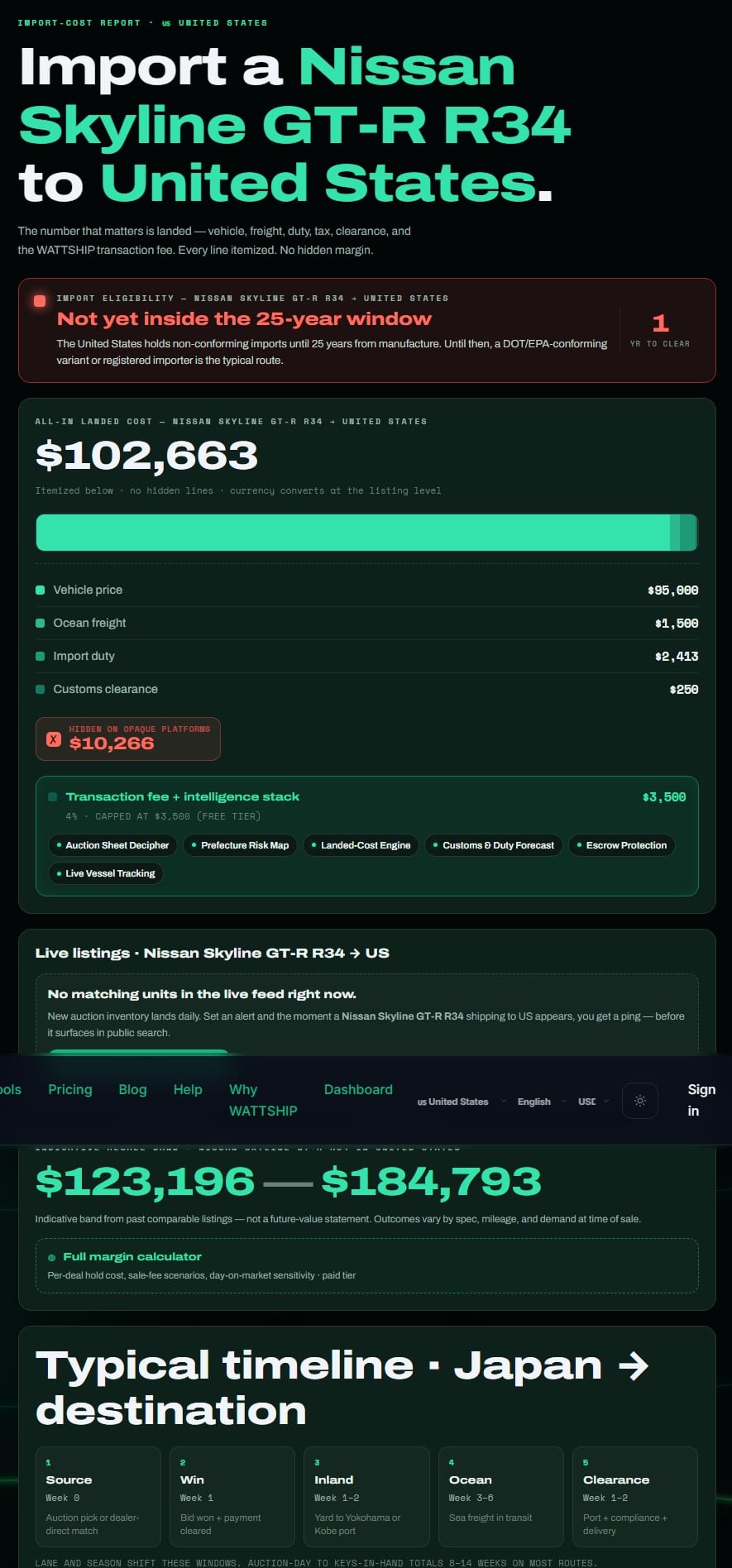
The hammer price is only the beginning. The true cost includes the auction fee, domestic transport to port, ocean freight, marine insurance, your destination’s import duty and consumption/sales tax, customs clearance, and local registration and compliance work.
- Vehicle price 52%
- Auction & fees 6%
- Freight 14%
- Insurance 2%
- Duty 12%
- Sales / VAT 8%
- Clearance 3%
- Compliance & reg. 3%
Stage 4 — Ship and clear customs
The exporter arranges domestic transport to a Japanese port and books ocean freight — either container (more protection; shared or whole) or roll-on/roll-off (RoRo — cheaper, less protection). Transit takes several weeks; vehicles from Japan typically arrive at US ports such as Los Angeles/Long Beach, Portland, or Baltimore. On arrival, a licensed customs broker files the entry with CBP, handling EPA form 3520-1 and DOT form HS-7 and selecting the applicable exemption. CBP verifies the build date against your export certificate and bill of lading before duty and tax are assessed.
Stage 5 — Register and drive
The final stage is making the car road-legal: any required compliance work, inspection, and registration. This stage is governed by local rules — clearing federal customs does not mean your state or region will automatically register the vehicle. Some US states add emissions requirements affecting certain imports even under the federal exemption. Check your local registration authority before you buy, not after.
Import rules by country
Eligibility overrides everything: a car can be a perfect buy and still be illegal to register where you live.
United States — the 25-year rule
The US operates a 25-year rule, a federal exemption (codified at 49 CFR 591.5(j)) that lets a vehicle be imported without meeting current Federal Motor Vehicle Safety Standards once it is 25 or more years old. The critical detail: eligibility is calculated by month of manufacture, 25 years before the date of entry — not by model year. As of January 2026, vehicles manufactured in January 1999 or earlier are eligible, with later-1999, 2000, and early-2001 builds rolling into eligibility month by month through 2026 and beyond. We break this down — including the month-of-manufacture cutoff — in our 25-year import rule guide.
The rule also carries a major 2026 cost advantage. A tariff introduced in 2025 added a steep additional duty on imported modern passenger vehicles and light trucks — but vehicles 25 or more years old are exempt from that additional tariff and pay only the standard rate.
The UK allows imports of all ages but requires an Individual Vehicle Approval (IVA) or registration under the applicable scheme, with VAT and duty payable on import. Older vehicles may qualify for reduced requirements. The cost stack is heavier than the US because of VAT.
Australia
Australia operates under the Road Vehicle Standards Act, with a Register of Approved Vehicles and the Specialist and Enthusiast Vehicle Scheme (SEVS) for eligible models. Rules are model-specific, so eligibility must be checked per vehicle.
Always verify current rules for your specific state, region, or territory before bidding — national rules set the floor, local registration authorities set the final word.
What does importing a car from Japan actually cost?
There is no single number — landed cost depends on the vehicle, destination, duty treatment, and shipping method. But the components are always the same:
- Vehicle price — the hammer or fixed price in yen
- Auction and exporter fees
- Domestic transport to a Japanese port
- Ocean freight — container or RoRo, by route
- Marine insurance — a small percentage of value
- Import duty — by destination, vehicle type, and (in the US) vehicle age, since the 25-year exemption changes the rate significantly
- Consumption/sales/VAT — by destination
- Customs clearance — broker and processing fees
- Local compliance and registration — varies most by jurisdiction
The reliable way to turn components into a real number is to run them for your exact vehicle and destination — which is what the Landed Cost Calculator is built to do.
Common mistakes first-time importers make
- Bidding before calculating landed cost. The hammer price is rarely more than two-thirds of the final figure.
- Ignoring the auction sheet. Photos sell; the inspection sheet tells the truth.
- Assuming eligibility. A car you can buy is not always a car you can register — and the month-of-manufacture cutoff catches people who count by model year.
- Misjudging duty. In 2026, a modern vehicle and a 25-year-old one face very different duty treatment in the US.
- Choosing the wrong shipping method. RoRo saves money but exposes the vehicle; containers protect it but cost more — and a shared container changes the math entirely.
Frequently asked questions
Is it cheaper to import a car from Japan?
Often, but not always. For models never sold in your market, or well-kept examples of cars that are expensive or worn-out domestically, importing can beat local prices even after shipping and duty — especially for vehicles old enough to qualify for the US 25-year exemption and its lower duty rate. Calculate the full landed cost and compare to local equivalents.
How long does it take to import a car from Japan?
From winning the vehicle to having it in your driveway typically takes several weeks to a few months, depending on shipping route, customs processing, and compliance work.
Do I need an exporter or agent?
For most buyers, yes. Japanese wholesale auctions are not generally open to foreign individuals, so you access them through an exporter or platform that bids on your behalf and handles export paperwork.
What documents do I need to import a car?
At minimum: the export certificate (de-registration document), the bill of lading, the commercial invoice, and any compliance paperwork your country requires. In the US that includes DOT form HS-7 and EPA form 3520-1, typically filed by a customs broker.
Can I import any car from Japan?
No. Eligibility depends on your country’s rules — most importantly age-based rules like the US 25-year rule, and model-specific schemes in markets like Australia. Always confirm eligibility before buying.
Start with the numbers
Importing rewards preparation. The buyers who do well read the auction sheet honestly and know their landed cost before they bid. Before you look at a single listing, run your destination and target vehicle through the Landed Cost Calculator. Then learn to read an auction sheet so condition can’t surprise you.
Sources
- U.S. Customs and Border Protection — Importing a Motor Vehicle
- NHTSA — How to Import a Vehicle / Form HS-7
- Federal Register / The White House — Adjusting Imports of Automobiles and Automobile Parts (2025 tariff proclamation)
- 49 CFR 591.5(j) — 25-year FMVSS exemption
WATTSHIP intelligence is for reference and estimation. Import rules, duty rates, and tariffs change; always confirm current requirements with CBP, NHTSA, EPA, and your local registration authority before purchasing. See our Disclaimer.