While the Supra became a legend for its bulletproof inline-six and the GT-R for its racing dominance, the Mazda RX-7 earned its place a different way entirely — by being unlike anything else on the road. The third-generation FD RX-7 is, for many enthusiasts, the most beautiful Japanese car ever made, and it’s powered by an engine no rival could match or copy: a spinning, screaming twin-turbo rotary. It’s the purest expression of Mazda’s decades-long obsession with the Wankel engine, and it’s a JDM icon for reasons that have nothing to do with the others.
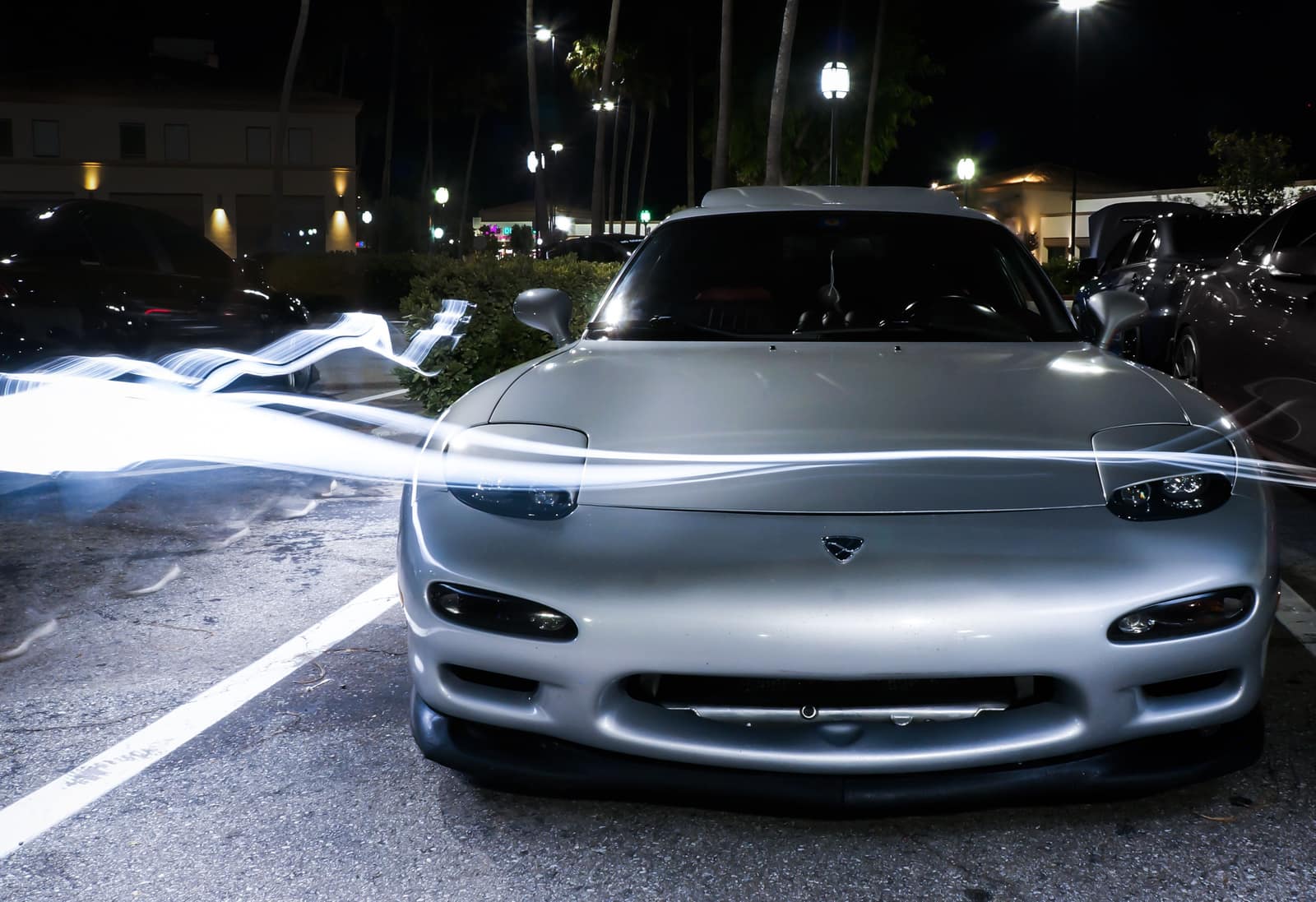 ## The FD, at a glance
The third and final RX-7 — chassis code FD3S — was produced from December 1991 to August 2002 in Japan, and sold in North America for just the 1993–1995 model years (only around 13,879 US-market cars). It was an outright, no-compromise sports car: an aerodynamic, organically-shaped body with pop-up headlights, a low nose, and near-50:50 weight balance, all wrapped around a curb weight of roughly 1,260 kg — remarkably light for a twin-turbo car.
- Years 1991–2002 (JDM) · 1993–1995 US-market (~13,879 cars)
- Chassis FD3S
- Engine 13B-REW — 1.3L sequential twin-turbo rotary
- Power 255 PS (1993) → 280 PS (2002)
- Drive Rear-wheel drive
- Weight ~1,260 kg — light for a twin-turbo car
- Balance Near 50:50
- Apex seals Compression-test before buying (warm, rotary tester)
- Top of range 2002 Spirit R — final 1,500 cars
The rotary: what makes it special (and tricky)
The heart of the FD is the 13B-REW — a 1.3-liter twin-rotor Wankel rotary engine, and the first-ever mass-produced sequential twin-turbo system exported from Japan. A small primary turbo gives low-speed response from around 2,500 rpm; a larger secondary spins up for high-rpm power. The result is smooth, lag-light, surging power and a sound unlike any piston engine. Output rose over the production run from 255 PS in 1993 to 280 PS by the end in 2002.
A rotary works completely differently from a normal engine: instead of pistons moving up and down, triangular rotors spin in oval chambers, sealed by apex seals rather than piston rings. This is what makes the rotary so compact, light, smooth, and high-revving — and it’s also what makes it demanding. Rotaries need specific maintenance, run hot, and the FD’s complex vacuum-actuated sequential-turbo system is where most ownership trouble begins when it’s neglected or poorly modified.
The one test that matters before buying
This is the single most important thing to know about buying an FD RX-7: get a warm compression test on a rotary-specific tester before you buy. Not a piston-engine gauge — a rotary one. Both rotors should read even across all three faces.
That one test separates a healthy car from a rebuild waiting to happen — the difference between a strong driver and a car that needs a costly engine rebuild can be tens of thousands of dollars. A healthy FD also restarts cleanly when fully warm; a long crank on a hot restart is a red flag for weak compression. Any FD purchase — especially an import you can’t inspect in person — should hinge on documented, healthy compression numbers.
Why values keep climbing
The FD has become a genuine collectible, and the reasons are specific to it: it’s stunning, it’s the last rotary RX-7, and its engine is irreplaceable in character. The limited-edition runs — especially the 2002 Spirit R (just 1,500 cars), which closed out production — lead pricing. As with the other legends, originality, condition, and a documented healthy engine drive value. Because rotaries are so often modified or poorly maintained, a clean, original, healthy FD is rarer than the production numbers suggest.
What to know about importing an RX-7 FD in 2026
- Eligibility: the FD3S is eligible for US import from the 1997 model year onward under the 25-year rule (earlier US-market 1993–1995 cars were sold here originally). For a JDM-spec import, confirm the build month — the rolling window covers more of the production run each year through 2027. (See the 25-year rule explained.)
- Compression first, everything else second. Insist on a warm rotary-tester compression reading before bidding. This is the make-or-break check.
- Beware heavy modification. Rotaries attract big-power builds; a poorly-done one is a money pit. Read the auction sheet for engine work and condition, and favor documented, original cars.
- It’s a 25-year classic — 2.5% duty, exempt from the 2025 modern-vehicle tariff. (See the tariff guide.)
- Run the landed cost and ship a clean FD in a container, not RoRo. Use the Landed Cost Calculator.
Frequently asked questions
Is the Mazda RX-7 FD legal to import to the US?
The FD3S is eligible from the 1997 model year onward under the 25-year rule (1993–1995 cars were originally US-market). For JDM imports, confirm the build month, as more of the 1992–2002 run becomes eligible each year.
What’s special about the RX-7’s rotary engine?
The 13B-REW is a 1.3L twin-rotor Wankel with the first mass-produced sequential twin-turbo system from Japan. Rotors spinning in oval chambers (sealed by apex seals, not piston rings) make it compact, light, smooth, and high-revving — and unlike any piston engine in feel and sound.
How much power does the RX-7 FD have?
The 13B-REW produced 255 PS in 1993, rising to 280 PS by the end of production in 2002.
What should I check before buying an FD RX-7?
A warm compression test on a rotary-specific tester — both rotors even across all three faces. This single test separates a healthy car from a costly rebuild. A clean hot restart (no long crank) is another health sign.
Why is the RX-7 FD so expensive now?
It’s the last rotary RX-7, widely considered one of the most beautiful JDM cars, with an irreplaceable engine. Limited editions like the 2002 Spirit R (1,500 cars) lead pricing, and clean, healthy, original cars are rarer than production numbers suggest.
The most singular of the legends
The RX-7 FD isn’t fast because of brute force or all-wheel-drive grip — it’s special because nothing else drives, sounds, or looks like it. That singularity is exactly why it endures. If the rotary icon is your dream, confirm eligibility in the 25-year rule guide, see the full 2026 JDM legends list, and run your numbers in the Landed Cost Calculator — but compression test first.
Sources
- JDMBUYSELL — 2026 Mazda RX-7 FD3S Buyer’s Guide (production, specs, compression-test guidance)
- evo — Mazda RX-7 FD (1992–2002): a ’90s Japanese icon
- Project JDM — RX-7 FD3S full specs (13B-REW sequential twin-turbo)
- Autopedia / Car Collection Wiki — 13B-REW output progression, Spirit R
WATTSHIP intelligence is for reference and estimation. Eligibility is by month of manufacture and must be verified per vehicle; this is not legal advice. See our Disclaimer.