Nissan Cedric Nissan Cedric 130
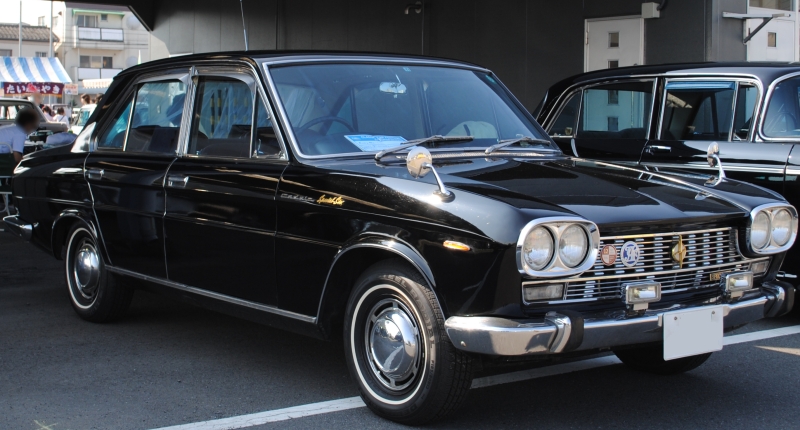
Nissan Cedric (Nissan Cedric 130) was built from 1965 to 1971, as a 4-door sedan/wagon/van. Powertrain: 2.0 L H20 I4 (130/V130/W130); 2.0 L J20 I6 (P130/VP130/WP130); 2.0 L L20 I6 (H130); 2.3 L L23 I6 (G130); 2.4 L L24 I6 (G130); 4.0 L Y40 V8…. Layout: FR layout. Size: 4,680 x 1,690 x 1,455 mm (L x W x H). Weight: 1280-1319 kg.
Composed from the specifications below, so it states nothing the specs do not. Photograph: Ypy31, Public domain (Wikimedia Commons), from this generation's own encyclopedia entry.
Overview
In August 1966, Nissan Motor Company and Prince Motor Company merged. Starting in 1967, the Cedric was sold in various export markets, as the Datsun 2000/2300/2400 rather than "Nissan Cedric". There were three body styles available: a four-door sedan, five-door station wagon (Wagon Six from 1967, WP130, later WH130) and a five-door van (Van Six from 1968, also as Van Deluxe Six for 1970, VP130, later VH130)
Source: the English Wikipedia article on this model, CC BY-SA 4.0. Text may be shortened; read the full article for the complete text.
Not yet sourced for this model. Used prices swing with year, mileage, grade and country, so we publish a market range only when it comes with a named source and a date, and never an estimate. For a live figure, use the landed-cost tool with the price on the auction sheet.
Against the other van / MPV models in this database (19 with this body type). Computed from the dimensions in the specifications, so it changes as the database grows.
- 105 mm below the median of 4,785 mm, and shorter than 92% of the 13 other van / MPV models in this database.
- about the same as the median of 1,700 mm, and narrower than 81% of the 16 other van / MPV models in this database.
- about the same as the median of 1,440 mm, and taller than 54% of the 13 other van / MPV models in this database.
- about the same as the median of 2,690 mm, and shorter than 82% of the 17 other van / MPV models in this database.
Who it suits
- Families, groups and shuttle work: the people-carrier body is built around seating and access.
- Executive and chauffeur use: the saloon body prioritises rear-seat comfort and a quiet cabin.
Check before you buy
- Check the emissions equipment (particulate filter, NOx treatment) and the destination country's emissions rules; some markets restrict used diesels.
- Inspect for corrosion at sills, floor, subframes and suspension mounts, and replace perishable rubber (hoses, bushes, boots) at import.
- Read the auction sheet grade and notes, and verify the odometer against service and inspection records. How to read an auction sheet
- Run a history check (accidents, flood, mileage) before you bid. History check guide
- Import age rules: this generation already qualifies in United States, Canada, United Kingdom, Australia. Confirm the rule for your exact vehicle with customs before buying. Landed-cost calculator
General guidance for this type of vehicle, worked out from its body, powertrain and age. It is not a finding about this particular model; use an inspection and the auction sheet for the car you are actually buying.
Worked out from this generation's production years and each country's age rule. Rules also depend on vehicle type and the month of manufacture, so confirm with customs before you buy.
Other generations of the Cedric
- Nissan Cedric 30 and 31 · 1960-1962 (30); 1962-1965 (31)
- Nissan Cedric 230 · 1971-1975
- Nissan Cedric 330 · 1975-1979
- Nissan Cedric 430 · 1979-1983
- Nissan Cedric Y30 · 1983-1987; 1983-1999 (wagon/van); 1990-1998 (China)
- Nissan Cedric Y31 · 1987-1991 (hardtop); 1987-2002 (sedan, fleet only until 2014)
- Nissan Cedric Y32 · 1991-1995
- Nissan Cedric Y33 · 1995 - 1999
- Nissan Cedric Y34 · 1999-2004
More from Nissan · all Nissan models
- Elgrand (Fourth generation) · 2026 - present
- Patrol (Seventh generation) · 2024-present
- Skyline (Thirteenth generation) · 2014 - 2022 (hybrid); 2014 - present (gasoline)
- Cima (Fifth generation (Y51)) · 2012-2022
- Fuga (Second generation (Y51)) · 2009-2022
- GT-R · 2007 - 2025
Can I import a Nissan Cedric (Nissan Cedric 130) from Japan?
By production year alone, Nissan Cedric (Nissan Cedric 130) is inside the age window for United States, Canada, United Kingdom, Australia. Rules depend on vehicle type and the month of manufacture, so confirm with customs before you buy.
What powers the Nissan Cedric (Nissan Cedric 130)?
Per its encyclopedia infobox, engine: 2.0 L H20 I4 (130/V130/W130); 2.0 L J20 I6 (P130/VP130/WP130); 2.0 L L20 I6 (H130); 2.3 L L23 I6 (G130); 2.4 L L24 I6 (G130); 4.0 L Y40 V8 (Police only); 2.2 L SD22 diesel I4 (Q130).
How big is the Nissan Cedric (Nissan Cedric 130)?
4,680 mm long and 1,690 mm wide and 1,455 mm tall, on a 2,690 mm wheelbase (4-door sedan/wagon/van). For container loading, use the container packer.
Answered from this page's own data, not from outside claims. See the sources below.
- en.wikipedia.org (retrieved 2026-10-19)
Confidence: single-source (Wikipedia infobox). Specifications differ by market, trim and model year; the auction sheet or the vehicle's registration document is the final word on a particular car.
- Complete guide · 12 minHow to Import a Used Luxury Car from Japan: Auction Grades, Paperwork and Country Rules (2026)How to import a used luxury car from Japan: what an auction grade means, how to check mileage and history, which export papers Japan asks for, and the age rules in the US, UK, Canada, Australia, New Zealand and Kenya.
- General import guide · 9 minHow Much Does It Cost to Import a Car from Japan? (2026)Shipping is only part of it. The real cost of importing a car from Japan stacks purchase, freight, duty, fees, and US-side costs. Here's the full breakdown for 2026, with a worked example.
- General import guide · 9 minThe 25-Year Import Rule, Explained (2026)The 25-year rule is the single most important law in car importing — and the most misunderstood. Here's how it actually works, by month of manufacture, with the EPA and NHTSA thresholds untangled.
- General import guide · 8 min7 Common Car Import Mistakes (and How to Avoid Them)Most import horror stories come down to a handful of avoidable mistakes. Here are the seven that cost first-time importers the most money and stress — and exactly how to avoid each one.
- General import guide · 8 minHow to Check a Used Car's History Before ImportingA clean photo and a low mileage number prove nothing on their own. Here's how to verify a Japanese car's real history — mileage, accidents, grade — before you commit a single yen.
- General import guide · 7 minContainer vs RoRo Shipping: Which to ChooseRoRo is cheaper; container is safer. The choice between the two main ways to ship a car from Japan comes down to your car's value and what you're willing to risk. Here's how to decide.